
Bringing the Sun to Earth
People keep asking me what exactly I do all day, and why I keep flying to the USA. This page is my answer: what fusion is, why it could power our everyday lives, and where my PhD fits into the picture. No physics degree required.
The Sun is a fusion power plant
Every second, deep inside the Sun, hydrogen nuclei crash into each other so hard that they stick together and become helium. The helium weighs a tiny bit less than the pieces it was made of. That missing mass turns into energy, Einstein's famous E = mc², and it is what makes sunlight.
On Earth the easiest version uses two heavy kinds of hydrogen: deuterium and tritium. They fuse into helium and a fast neutron, whose energy heats water, drives a turbine and makes electricity, just like in any other power station.
A ridiculous amount of energy in very little fuel
Burning coal or gas only rearranges the electrons in a molecule. Fusion changes the nuclei themselves, and that releases roughly ten million times more energy per kilogram.
On top of that, fusion:
- releases no CO₂ at all,
- produces helium, the gas in party balloons, as its “ash”,
- cannot run away or melt down, as fission could,
- runs on fuel that every country on Earth has.
One gram of fusion fuel releases about as much energy as 14 tonnes of coal or 9,500 litres of oil.
A small lake could power the whole world
Deuterium isn't rare at all: it is in every glass of water. Only about one hydrogen atom in 6,400 is deuterium, but there is so much water, and fusion is so powerful, that this adds up fast.
Tritium, the second ingredient, is radioactive and barely exists in nature, so a power plant makes its own: it is bred from lithium, the same light metal that is in your phone battery. The neutron set free by every fusion reaction hits lithium in the wall around the plasma and turns it into fresh tritium.
Every fusion reaction releases a neutron. In a blanket of lithium around the plasma, it splits a lithium atom and makes new tritium.
Assumes deuterium–tritium fusion, with the tritium made from lithium inside the reactor, and compares the heat released to the ≈ 620 EJ of primary energy humanity uses each year. Real power plants lose part of that heat when turning it into electricity, so read these as orders of magnitude.
You can't build a Sun out of a box
The Sun squeezes its fuel together with its enormous gravity. We can't do that, so instead we make it hotter: about 150 million °C, ten times hotter than the centre of the Sun. No material in the world survives that. The trick is to never let the fuel touch anything, and hold it in a cage made of magnetic fields instead.
Tokamak and stellarator
There are two main ways to twist the magnetic field. Below, the red dot travels once around each machine, seen from above, and on the right you see a slice through the plasma at that spot. In a tokamak the slice always looks the same. In a stellarator it keeps changing shape: this is the real cross-section of STAR_Lite, the machine I work on.
Tokamak
e.g. ITER, ASDEX Upgrade+ Simple, symmetric, very well studied. The twist comes from a huge electric current driven through the plasma itself.
– That current must be driven and controlled, and if it collapses the plasma can crash into the wall (a disruption).
Stellarator
e.g. Wendelstein 7-X, STAR_Lite+ The twist is built into the shape of the magnets, so no big plasma current is needed: it can run steadily, like a power plant should.
– Every coil is a twisted 3D shape that must be designed by computer optimisation and built very precisely.
Every fire needs a chimney
A fusion plasma constantly produces helium “ash” and leaks heat. If the ash stays in, it smothers the fire. If the heat hits the wall in the wrong place, it melts it. Every reactor therefore needs an exhaust system, called a divertor: a special region where the magnetic field guides escaping particles onto sturdy plates and towards pumps.
Tokamaks have a neat solution: the field lines cross at an “X-point” and lead the exhaust down into a chimney. The big stellarator Wendelstein 7-X uses a different trick that handles heat well, but it pumps out less than 1% of the particles reaching it, and it shifts around when the plasma changes.
The idea behind STAR_Lite: give a stellarator a tokamak-style chimney that stays put whatever the plasma does.
STAR_Lite: a stellarator on a table
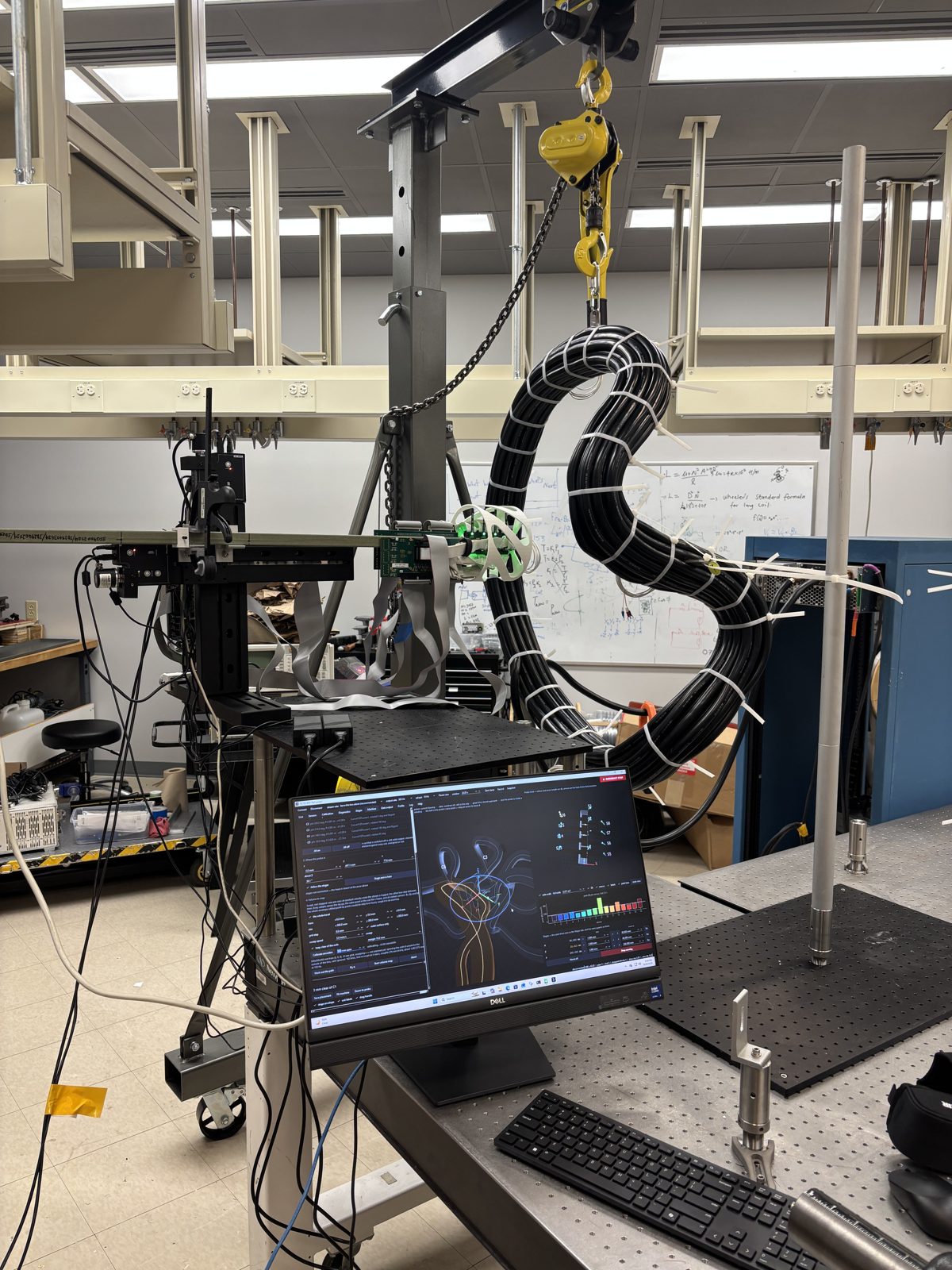
STAR_Lite is a small stellarator being built at Hampton University in Virginia, designed to test exactly this chimney idea. It is small enough to fit on a 2 × 3 m lab table, has six coils of only two different shapes, and will heat its plasma with microwaves at 2.45 GHz: the same frequency as your kitchen microwave, just a lot more of it.
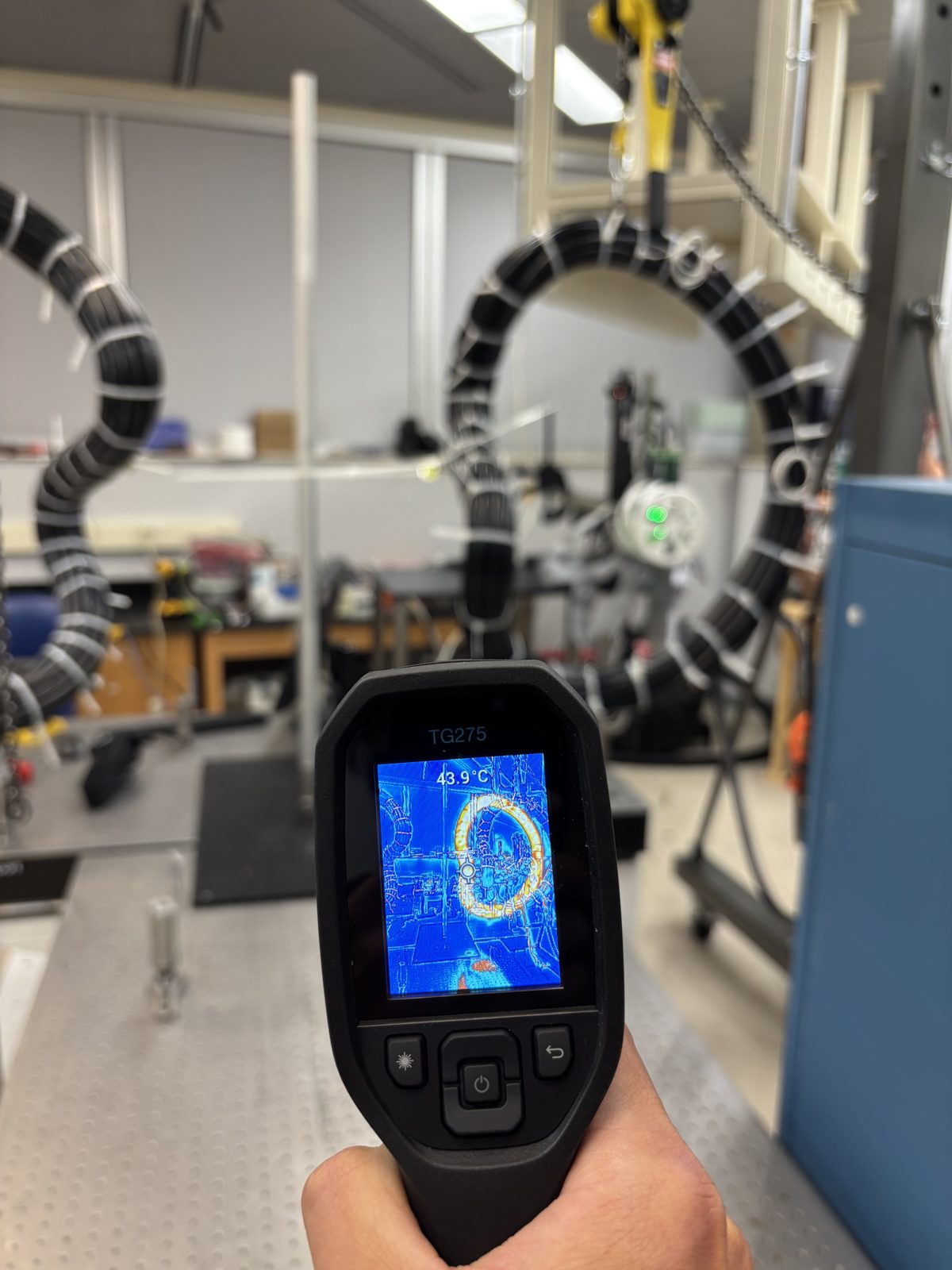
The coils are wound, and this summer we mapped their magnetic field with a robotic sensor I helped build. Read that story here
Designing the chimney, by simulation
My job is to design STAR_Lite's vacuum chamber, the airtight shell the plasma lives in, and the divertor inside it: where exactly the heat lands on the walls, what shape the plates need, and where to put the pumps so the helium ash actually gets out.
That last part matters at least as much as the heat. The particles that hit the plates turn back into neutral gas, and a reactor has to pump that gas away continuously: otherwise the helium ash piles up and smothers the fire. So the chamber has to steer this gas into the pumping ports instead of letting it drift back into the plasma.
Since the machine doesn't have a plasma yet, I do this in the computer. My simulations follow the magnetic field and the hot particles from the edge of the plasma all the way to the wall, thousands of times over, for every way STAR_Lite can be run. Then we change the design and run them again.
Finally I scale the design up: to the size of existing research machines, where real measurements exist to compare against, and all the way to a power-plant-sized stellarator, to see whether the chimney idea still works where it really matters.
- Simulate the plasma edge
- Find where heat and particles land
- Reshape the chamber, move the pumps
- Repeat
Illustration: shapes and numbers are made up, not simulation results.
Why I work with mathematicians
Designing a stellarator is a giant puzzle. The shape of each twisted coil is described by hundreds of numbers, and changing any one of them changes the whole magnetic field. Nobody can solve that by hand, so the computer searches for good designs, a process called optimisation.
Some of the best tools for this are built by mathematicians at the Flatiron Institute of the Simons Foundation in New York. Together we developed new mathematics that lets the computer design the coils, the chimney and the chamber walls at the same time, instead of one after another. Usually the chamber is squeezed in at the very end, around whatever the magnets demand.
That made it possible to let the computer dream up a whole galaxy of possible STAR_Lites, around 40,000 of them, each with a different kind of chimney, which we are now sorting through to pick the most promising ones.
One project, four places
The machine is in Virginia, the mathematicians are in New York, my university is in Vienna, and the world's largest stellarator and its experts are in Germany. My PhD sits right in the middle, so I travel between them: to Hampton to work on the real machine, to New York to work on the maths, and to the Max Planck Institute for Plasma Physics for its simulation expertise.
This work is supported by the U.S. Department of Energy (RENEW and FAIR programmes), the Simons Foundation and the Friedrich Schiedel Foundation for Energy Technology.
Questions I get asked a lot
Want the grown-up version?
The published papers behind this page, for the curious: